
Jiayu Pass
Westernmost Ming Great Wall fortress and Silk Road gateway.

via Wikipedia: Jiayu Pass · see source
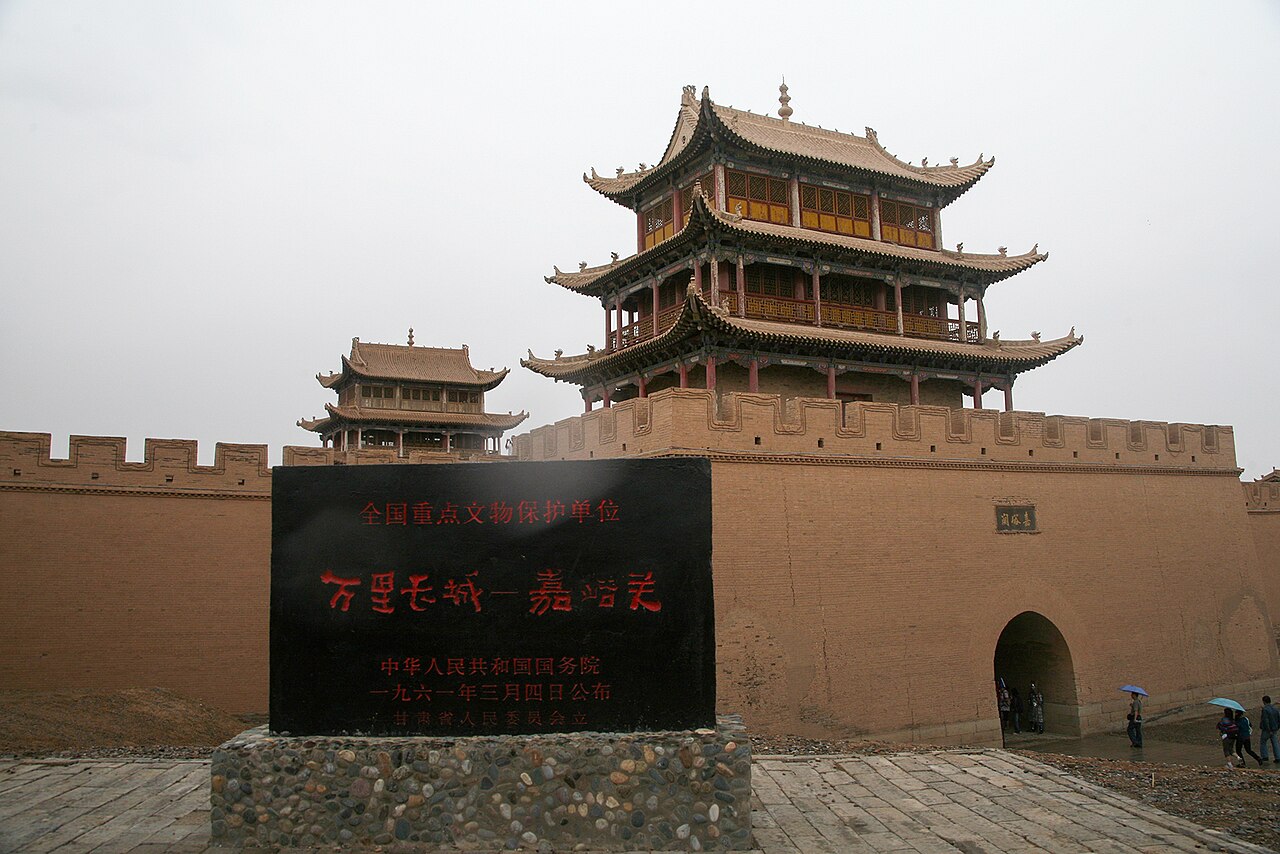
Jiayu Pass (simplified Chinese: 嘉峪关; traditional Chinese: 嘉峪關; pinyin: Jiāyù Guān) is the first frontier fortress at the west end of the Ming dynasty Great Wall, near the city of Jiayuguan in Gansu province. Along with Juyong Pass and Shanhai Pass, it is one of the main passes of the Great Wall. In the Ming period, foreign merchants and envoys from Central Asia and West Asia mostly entered China through Jiayu Pass.
- location
- Narrowest point of the western Hexi Corridor, 6 km southwest of Jiayuguan, Gansu
- built
- Early Ming dynasty, around 1372
- perimeter
- 733 meters
- area
- More than 33,500 square meters
- height
- 11 meters
- known_for
- Most intact surviving ancient military building on the Great Wall; key waypoint
Lore & Background
The pass was built during the early Ming dynasty, around 1372. The fortress was greatly strengthened due to fear of an invasion by Timur, but Timur died of old age while leading an army toward China. The structure lies between two hills, one of which dominates Jiayuguan Pass, and was built near an oasis that was then on the extreme western edge of China.
Reader's Guide
Jiayu Pass is significant as the most intact surviving ancient military building among the Great Wall passes. It was a key waypoint of the ancient Silk Road, through which foreign merchants and envoys from Central Asia and West Asia entered China during the Ming period. The pass also holds a fearsome reputation: Chinese people who were banished were ordered to leave through Jiayu Pass for the west, the vast majority never to return. Traveler Mildred Cable, who visited in 1923, noted it was known as Kweimenkwan (Gate of the Demons) and described the western gate as the 'Gate of Sighs,' covered with writings by exiles, disgraced officials, and criminals. Among those banished was Commissioner Lin Zexu, a famous Chinese Opium War viceroy. Thousands of tombs from the Wei and Western Jin dynasty (266–420) have been discovered east of the city, with 700 excavated tombs famous for bricks depicting domestic scenes.
Did You Know?
- The fortress was greatly strengthened due to fear of an invasion by Timur, but Timur died of old age while leading an army toward China.
- A local legend says the designer estimated 99,999 bricks, added one more at the official's request, and the extra brick remains loose on a gate to this day.
- In 1923, traveler Mildred Cable called the western gate the 'Gate of Sighs,' noting its archway was covered with writings by exiles and disgraced officials.
- Among those banished through Jiayu Pass was Commissioner Lin Zexu, the famous Opium War viceroy, whose statue now stands in a park in Ürümqi.
- Thousands of Wei and Western Jin dynasty tombs (266–420) have been discovered east of the city; their painted bricks depict domestic scenes like roasting meat and picking mulberries.
Architecture & Defensive Design
Standing at the tightest pinch of the western Hexi Corridor, Jiayu Pass was engineered as a layered military stronghold. Its trapezoid footprint encloses more than 33,500 square metres within a perimeter of 733 metres, and its walls rise to a height of 11 metres. Two principal gates punctuate the structure—one facing east, the other west—each crowned by a gatehouse. A tablet bearing the characters for "Jiayuguan" is mounted above the western gatehouse. Turrets anchor all four corners, while the northern and southern flanks link directly into the broader Great Wall system. Inside, broad roads on the north side climb to the wall's crest. The defensive scheme operated on three concentric levels: an inner fort, an outer fort, and a surrounding moat. The entire complex was sited between two hills, one of which still dominates the skyline, and near an oasis that, in the Ming era, marked the far western fringe of Chinese territory.
Gateway to the Silk Road
For centuries, Jiayu Pass served as the principal western gateway through which the outside world entered China. During the Ming dynasty, merchants and diplomatic envoys traveling from Central Asia and West Asia overwhelmingly channeled their journeys through this single chokepoint, making it a bustling crossroads of commerce and culture. Its strategic position at the narrowest section of the Hexi Corridor meant that any overland traffic from the west had to funnel through a corridor barely wide enough for a few carts, giving the garrison extraordinary control over who passed and who did not. Together with Juyong Pass to the south and Shanhai Pass at the eastern terminus, Jiayu Pass formed one of the three great controlled crossings of the Ming Great Wall. The fortress was deliberately sited beside an oasis that, in the fourteenth and fifteenth centuries, represented the extreme western edge of settled Chinese territory—a threshold between the cultivated lands of the interior and the vast, arid expanses of the Gobi beyond.
The Gate of Exile
Beyond its military and commercial roles, Jiayu Pass carried a deeply somber association in Chinese memory. It was the designated exit point for those banished from the empire—disgraced officials, convicted criminals, and heavy-hearted exiles ordered to walk westward into the Gobi Desert, the vast majority of whom never saw their homeland again. In 1923, American traveler Mildred Cable recorded the gate's grim nickname, "Gate of the Demons," and described the deep archway tunnelled through the wall's thickness as a "Gate of Sighs." She noted that the long arch was covered with inscriptions left by scholars who had fallen into deep distress—an anthology of grief written by men torn from everything they loved. Among those who passed through in disgrace was Lin Zexu, the famous Commissioner of Liangguang during the Opium War era, whose statue now stands in a park in Ürümqi. For generations, the pass was less a triumph of engineering than a threshold of loss.
Construction, Legend & Enduring Legacy
Jiayu Pass was raised in the early Ming dynasty, around 1372, and was subsequently reinforced when the empire feared a massive invasion by the Central Asian conqueror Timur. That threat ultimately dissolved when Timur died of old age while his army was still en route. A beloved local legend adds a human touch to the construction story: the overseer asked the designer to estimate the brick count, received the figure 99,999, and pressed him to add one more. When the fortress was complete, exactly one brick remained, and it was set loose atop one of the gates, where it is said to rest to this day. Today, Jiayu Pass is regarded as the most intact ancient military structure among all the Great Wall passes, earning the epithet "Greatest Impregnable Pass Under Heaven." East of the modern city, thousands of Wei and Western Jin dynasty tombs have been unearthed; their painted bricks—depicting feasts, mulberry-picking, and herding scenes—are reproduced in nearly every major Chinese museum, though only one of the eighteen excavated tombs is open to visitors.
Gallery
Frequently Asked Questions
What is Jiayu Pass?
It is the westernmost military fortress on the Ming dynasty Great Wall, perched at the narrowest pinch point of the Hexi Corridor in Gansu province. In simple terms, it marks the last solid gate before the open Gobi desert stretched westward.
Where exactly is it and when was it built?
The fortress sits about 6 km southwest of modern Jiayuguan city, right at the tightest section of the western Hexi Corridor. Construction was launched in the early Ming period, around 1372.
What role did Jiayu Pass play in Ming-era trade and diplomacy?
It functioned as the principal gateway through which Central Asian and West Asian merchants and envoys entered China proper. Together with Juyong Pass and Shanhai Pass, it formed one of the three main Great Wall gateways.
What makes Jiayu Pass stand out among other Great Wall fortifications?
It is widely regarded as the most intact surviving ancient military structure on the entire Great Wall. The complex spans roughly 733 meters in perimeter, covers more than 33,500 square meters, and rises about 11 meters high.
Why is Jiayu Pass significant to the broader Silk Road story?
As the westernmost Ming frontier stronghold, it marked the practical edge of Chinese imperial control and the last major checkpoint before the open desert routes led west. For centuries it was the key funnel point where Silk Road commerce and diplomacy poured into China.
More in Chinese History 1-24
Elsewhere in the Chinese History universe
Spotted an error? Know more?
This is a living reference — every entry is fact-audited, and reader corrections feed straight into our audit queue. Suggest an edit · See this site's audit record